
In modern sanitary napkin manufacturing, material selection plays a crucial role in determining product performance, comfort, and consumer satisfaction. Among the various functional materials used in production lines, perforated PE film has become an essential component in many sanitary napkin designs. Its unique structure and performance characteristics make it highly suitable for high-speed production and advanced feminine hygiene products.
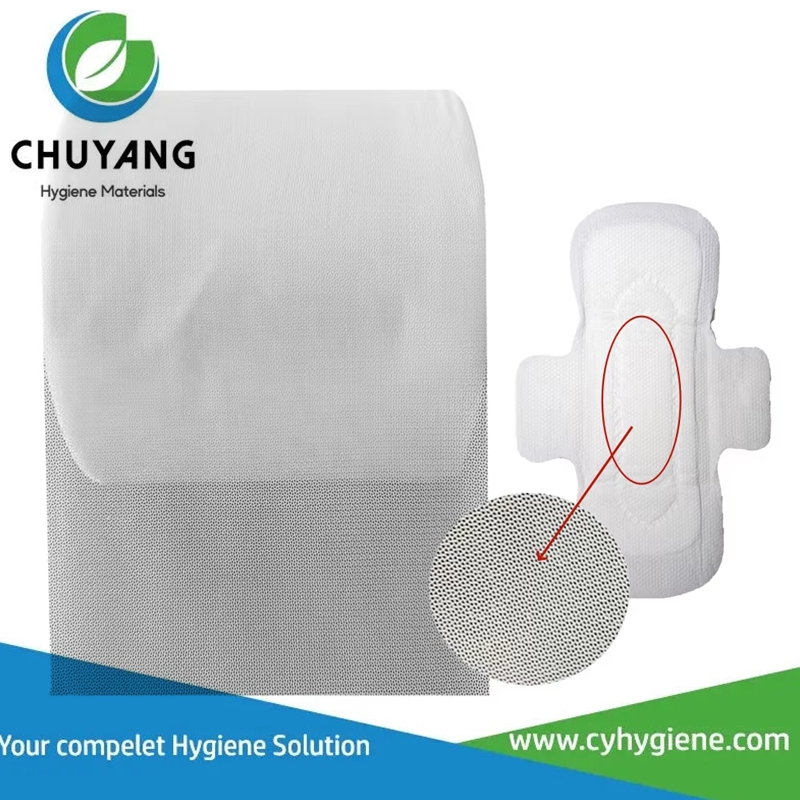
Perforated PE film refers to polyethylene film that has been mechanically or thermally perforated to create uniform micro-holes across the surface. These perforations allow controlled liquid transfer while maintaining the film’s structural integrity. In sanitary napkin production lines, perforated PE film is commonly used as a functional layer that balances liquid penetration, airflow, and surface comfort.
1. Enhancing Liquid Penetration and Distribution
One of the primary reasons sanitary napkin production lines use perforated PE film is its ability to improve liquid penetration into the absorbent core. The micro-perforations allow menstrual fluid to pass through the film quickly and evenly, reducing surface pooling and helping the absorbent core work more efficiently.
Compared with non-perforated PE film, perforated PE film enables faster fluid intake, which is especially important during sudden or heavy flow. This helps minimize rewet and reduces the risk of leakage, improving overall product reliability.
2. Improving Breathability and Wearing Comfort
Breathability is a key factor in modern feminine hygiene products. Perforated PE film introduces controlled airflow through the micro-holes, allowing moisture vapor to escape while still maintaining liquid resistance in the overall product structure.
In sanitary napkin production, this feature helps reduce heat and humidity buildup during use, contributing to better skin comfort and reducing irritation. As consumer awareness of comfort and skin health increases, perforated PE film has become a preferred choice for mid-to-high-end sanitary napkin products.
3. Supporting High-Speed Production Line Stability
Sanitary napkin production lines operate at high speeds and require materials with stable mechanical properties. Perforated PE film is engineered to maintain consistent tensile strength and dimensional stability, even after the perforation process.
This stability ensures smooth unwinding, accurate positioning, and reliable lamination during continuous production. For manufacturers, using perforated PE film helps reduce downtime caused by material breakage, misalignment, or inconsistent feeding, ultimately improving production efficiency and output consistency.
4. Compatibility with Multi-Layer Sanitary Napkin Structures
Modern sanitary napkins consist of multiple layers, including top sheets, acquisition layers, absorbent cores, and backsheet materials. Perforated PE film is highly compatible with these composite structures and can be integrated between different layers depending on product design.
It works well with nonwoven fabrics, hot melt adhesives, and absorbent materials, allowing manufacturers to customize product structures for different market segments. This flexibility makes perforated PE film suitable for a wide range of sanitary napkin designs, from standard daily use products to premium breathable options.
5. Balancing Cost and Performance
From a manufacturing perspective, perforated PE film offers an effective balance between cost and performance. While it provides functional benefits such as improved fluid transfer and breathability, it remains economical compared to more complex membrane materials.
This makes perforated PE film an attractive option for sanitary napkin manufacturers looking to upgrade product performance without significantly increasing production costs. As a result, it is widely adopted across both emerging and mature markets.
Perforated PE film has become an important material in sanitary napkin production lines due to its ability to enhance liquid penetration, improve breathability, support high-speed manufacturing, and integrate seamlessly into multi-layer product structures. Its balanced performance and cost-effectiveness make it a reliable choice for modern feminine hygiene product design.
As sanitary napkin technology continues to evolve, perforated PE film will remain a key material supporting innovation, comfort, and manufacturing efficiency in the feminine hygiene industry.