
To meet the production demands of hot-air nonwoven fabrics for diapers, this study explores the relationship between the differences in bicomponent fibers and the performance of hot-air nonwoven fabrics. Hot-air nonwoven fabrics of the same basis weight were prepared using the same process route but with different linear densities and hydrophilic types of bicomponent composite fibers. The effects of these differences in bicomponent fibers on the mechanical properties, softness, bulkiness, liquid penetration time, and rewetting amount of the hot-air nonwoven fabrics were analyzed through experimental testing. The results show that fiber linear density and hydrophilicity significantly affect the performance of hot-air nonwoven fabrics. Improving diaper performance requires focusing on the balance between porosity and softness of the hot-air nonwoven fabric, as well as the relationship between penetration time, rewetting amount, and backflow amount.
With the rapid economic and social development in my country, people's living standards have continuously improved, and their health awareness has increased. Disposable hygiene products have become a necessity in daily life. Among them, disposable diapers are widely used among infants and the elderly with incontinence, and their market penetration rate continues to rise. In addition, factors such as the relaxation of birth control policies, accelerated urbanization, an increasing elderly population, and a large population base have jointly driven the continuous development of the diaper market.
While the market share of diapers in China is increasing, consumers are also becoming more demanding regarding product quality. Hot-air nonwoven fabric, as a main component of diapers, has attracted widespread attention [1]. However, due to the relatively small proportion of domestic hot-air nonwoven fabrics in industrial textiles, there is limited research on its relationship with diaper performance. Cutting-edge technologies related to diapers are mostly held by large foreign companies such as Kimberly-Clark, Procter & Gamble, Johnson & Johnson from the United States, and Unicharm and Kao from Japan.
Due to the lack of theoretical knowledge about diapers among some domestic production personnel, the nonwoven materials and their functions produced fail to meet the design requirements and cannot satisfy the usage requirements of downstream hygiene products. Furthermore, under the same weight conditions, the thickness of hot-air nonwoven fabric is approximately three times that of nonwoven materials produced by other processes. The intricate spatial structure created by the heat-induced curling of fibers increases the gaps between fibers, and a certain degree of bulkiness affects the upward channel of penetrating liquids. Therefore, hot-air nonwoven fabric is very suitable as a material to prevent liquid backflow, significantly reducing the amount of liquid backflow. Therefore, there is an urgent need for a deeper analysis and research on the relationship between different bicomponent composite fibers and the performance of hot-air nonwoven fabrics used in diapers.
Based on this, our company used the same process route and different linear densities and hydrophilic types of bicomponent composite fibers to prepare hot-air nonwoven fabrics of the same weight. Through experimental testing and analysis, we explored the impact of differences in bicomponent fibers on the mechanical properties, softness, bulkiness, liquid penetration time, and backflow amount of hot-air nonwoven fabrics used in diapers, providing a reference for the production of hot-air nonwoven fabrics for diapers.1. Overview of Hot Air Nonwoven Fabric Production
1.1 Raw Material Selection
Hot air nonwoven fabrics are mostly made from sheath-core bicomponent composite fibers (ES fibers).
The three commonly used polymer raw materials for preparing these fibers are polyethylene (PE), polypropylene (PP), and polyethylene terephthalate (PET). Among these, PE/PET type ES fibers have a relatively lower modulus, resulting in a better feel for the resulting hot air nonwoven fabric. Therefore, PE/PET type ES fibers are chosen as the raw material. In this case, the sheath component of the composite fiber is PE, with a melting point of approximately 130 ℃; the core component is PET, with a melting point of approximately 240 ℃.
1.2 Production Process Flow
The production of hot air nonwoven fabrics utilizes the thermoplasticity of polymer materials. A hot air stream above 130 ℃ is used to penetrate the fiber web, causing the low-melting-point sheath component of the bicomponent composite fiber to soften, melt, and bond, while the higher-melting-point core component acts as a support. The production process flow is shown in Figure 1.
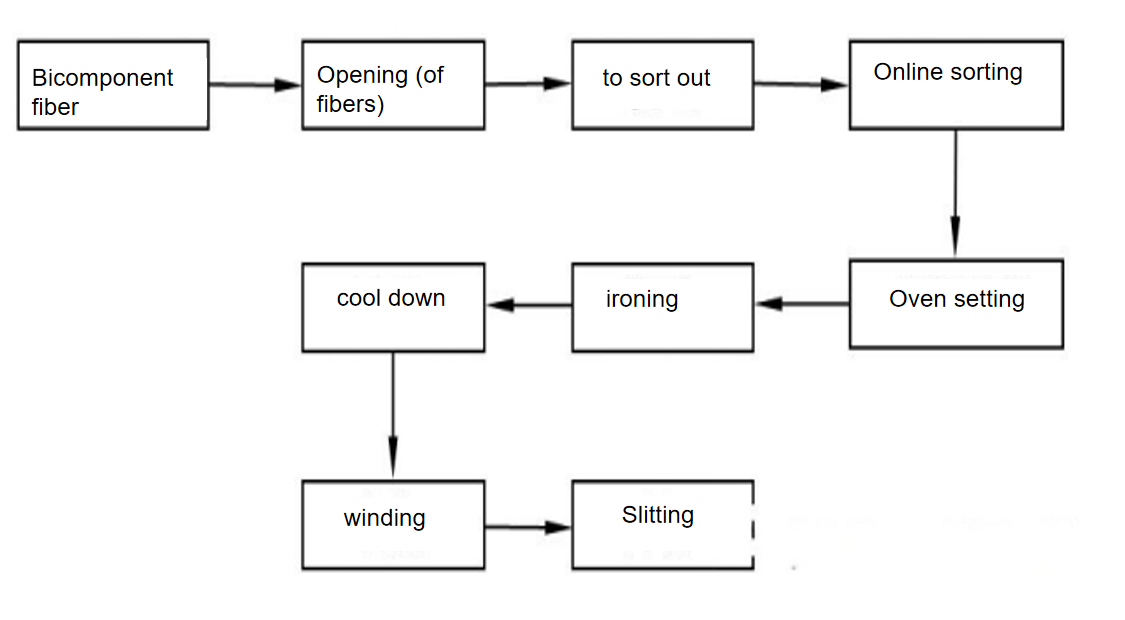
The process flow is as follows: Two-component fibers are fed into an opening machine, then transported via a pneumatic cotton box to one or two double-cylinder double-doffer carding machines for carding into a web. The resulting two-component fiber web is laid and conveyed into a flat-bed hot air oven. Under the action of hot air at a certain temperature and speed, the outer layer melts and bonds at the fiber intersections, providing reinforcement. Further processing includes calendering, cooling, winding, and slitting, ultimately yielding a hot-air nonwoven fabric. Depending on the application, different two-component fibers can be selected to produce hydrophilic or hydrophobic hot-air nonwoven fabrics. Typically, hydrophilic hot-air nonwoven fabric is used as the top layer of diapers to improve their feel and liquid absorption performance; hydrophobic hot-air nonwoven fabric, after being laminated with a PE breathable film, is used as the bottom layer of diapers. Hydrophilic hot-air nonwoven fabrics are further classified into single-use hydrophilic, multi-use hydrophilic, and weakly hydrophilic types, depending on the type of fiber used. This paper mainly discusses the impact of hot-air nonwoven fabrics made from different types of fibers, when used as the top layer of diapers, on product performance.
2. Experimental Design
2.1 Experimental Materials and Sample Preparation
To avoid introducing confounding variables, all different types of hot-air nonwoven fabrics used in the experiment had a unit area weight of 20 g/m2 and were manufactured by Shandong Derun New Material Technology Co., Ltd. The bicomponent fibers selected were PE/PET core-sheath composite fibers with different linear densities and different hydrophilic finishing agents. The sample parameters are shown in Table 1. All bicomponent fiber raw materials were provided by Quanzhou Xiamei Fiber Products Co., Ltd.

The temperature and relative humidity changes in the hot-air nonwoven fabric production workshop have a significant impact on the final product performance data. Therefore, the sample preparation environment should be controlled as much as possible at a temperature of (25±2)℃ and a relative humidity of (65±5)%.
The hot-air nonwoven fabric was prepared from the two-component material according to the above-mentioned hot-air nonwoven fabric production process.
2.2 Performance Testing Methods
A Z01B disc sampler was used to test the unit area mass of the samples according to GB/T 24218.1—2010 "Textiles - Nonwoven Fabrics Test Methods - Part 1: Determination of Unit Area Mass"; a YG814D digital fabric thickness gauge was used to test the thickness of the samples according to GB/T 24218.2—2010 "Textiles - Nonwoven Fabrics Test Methods - Part 2: Determination of Thickness"; a YG026H-50 electronic tensile testing machine was used to test the longitudinal/transverse breaking strength and elongation of each sample according to GB/T 24218.3—2010 "Textiles - Nonwoven Fabrics Test Methods - Part 3: Determination of Breaking Strength and Breaking Elongation (Strip Method)"; a DRK119 softness tester was used to test the softness of the samples according to GB/T 8942—2002 "Determination of Paper Softness"; a YG814D liquid penetration tester was used to test the liquid penetration time of the samples according to GB/T 24218.13—2010 "Textiles - Nonwoven Fabrics Test Methods - Part 13: Determination of Multiple Liquid Penetration Time"; a WETBACK rewetting tester was used to test the rewetting amount of the samples according to GB/T 24218.14—2010 "Textiles - Nonwoven Fabrics Test Methods - Part 14: Determination of Rewetting Amount of Covering Materials". 3. Results and Analysis
3.1 Test Results
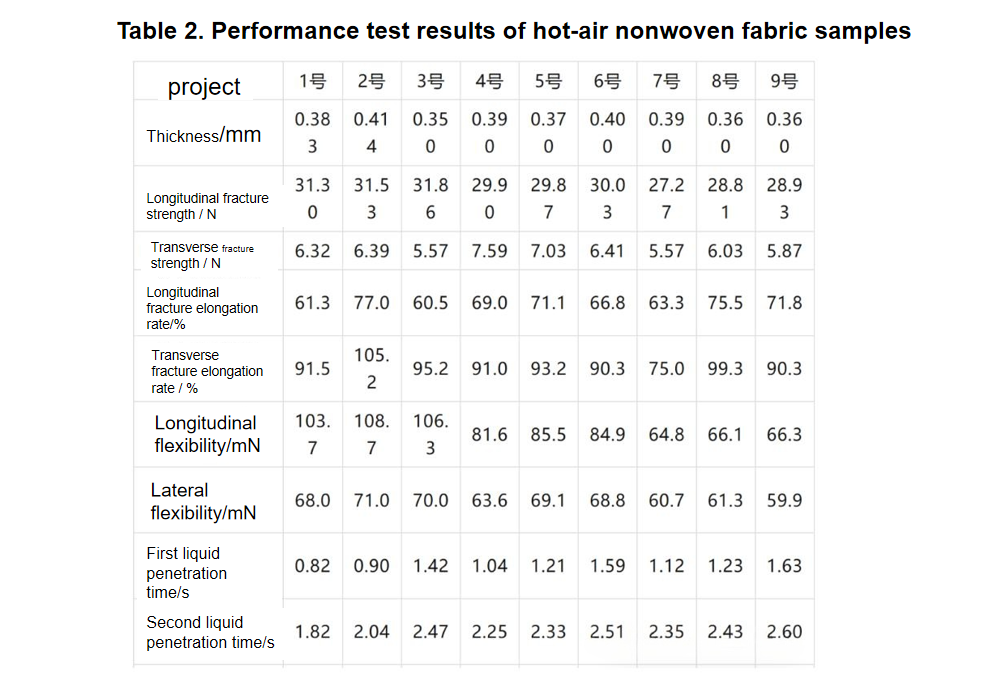
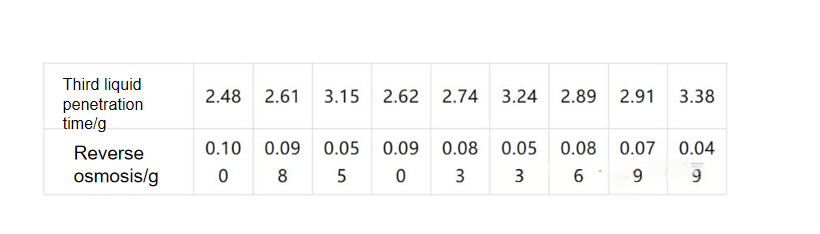
The performance test results of the hot air nonwoven fabric samples are shown in Table 2.
3.2 Results Analysis
3.2.1 Influence of Fiber Linear Density on the Performance of Hot-Air Nonwoven Fabrics
As a surface material, hot-air nonwoven fabric directly contacts the skin of infants and young children, requiring high demands on the material's texture and flexibility. Therefore, fibers with high linear density cannot be used. When selecting the fiber linear density parameter in this example, the following properties should be considered comprehensively.
3.2.1.1 Thickness (Bulkiness)
Through thickness testing of hot-air nonwoven fabrics made from fibers with different linear densities, it can be seen that the fiber difference has little effect on the thickness or bulkiness of the hot-air nonwoven fabric; the thickness of the hot-air nonwoven fabric mainly depends on the process configuration of hot-melt bonding, such as the effect of oven temperature on the shrinkage of the fabric surface caused by the shrinkage stress of the fibers after the melting of the sheath of the bicomponent composite fibers, the smoothing effect of the calender on the short fiber fluff on the surface of the hot-air nonwoven fabric, and the cooling and shaping effect of the cooling machine on the three-dimensional structure between the fibers.
3.2.1.2 Breaking Strength and Softness
In terms of breaking strength, the breaking strength of the hot-air nonwoven fabric slightly decreases with decreasing fiber linear density. This is because, for hot-air nonwoven fabrics of the same weight per unit area, a smaller fiber linear density results in a smaller bonding area between fibers, leading to a slight decrease in strength. The longitudinal tensile breaking strength of each sample is greater than the transverse strength, indicating that the hot-air nonwoven fabric is formed using a direct laying method, with the fibers primarily arranged longitudinally. This is specifically manifested as the longitudinal tensile breaking strength being greater than the transverse tensile breaking strength, with a significant difference between the longitudinal and transverse strengths. However, the fiber web has good uniformity, so the strength difference between each group of samples during actual testing is not significant.
Softness is an important indicator characterizing the comfort of diapers. In terms of softness, the softness of the hot-air nonwoven fabric also decreases with decreasing fiber linear density, indicating that the external force required to bend the material decreases. This shows that the finer the bicomponent fibers, the better the softness of the hot-air nonwoven fabric.
3.2.1.3 Liquid Penetration Time and Backflow Volume
In terms of liquid penetration time, the hot-air nonwoven fabrics prepared from fibers with linear densities of 0.17 tex and 0.13 tex exhibited longer penetration times and slower penetration compared to fibers with a linear density of 0.22 tex. Regarding backflow volume, the nonwoven fabrics made from fibers with linear densities of 0.22 tex and 0.17 tex showed higher liquid backflow volumes than those made from fibers with a linear density of 0.13 tex. This is mainly because the hot-air nonwoven fabric has a three-dimensional spatial structure with numerous interconnected pores within the material. The liquid penetrates and diffuses through the capillary effect between the fibers and is absorbed by the absorbent core. Under a certain external pressure, the liquid is easily squeezed out, resulting in a larger backflow volume. However, as the fiber linear density decreases, the porosity of the nonwoven fabric decreases. Due to the overly compact fiber distribution, the density of the fiber surface increases, significantly reducing the gaps between the fibers. This structural change increases the resistance to liquid diffusion to the lower layers, leading to a slower liquid penetration rate; similarly, after the liquid has penetrated, the backflow volume will also decrease due to the smaller gaps between the fibers.
3.2.2 Influence of Fiber Hydrophilicity on the Properties of Hot-Air Nonwoven Fabrics
3.2.2.1 Thickness (Bulkiness)
Thickness tests on hot-air nonwoven fabrics made from fibers with different hydrophilicities showed that different fiber materials had little effect on the thickness or bulkiness of the hot-air nonwoven fabrics.
3.2.2.2 Breaking Strength and Softness
Regarding breaking strength and softness, different hydrophilic fibers had little impact on the breaking strength and softness of the resulting hot-air nonwoven fabrics.
3.2.2.3 Liquid Penetration Time
Comparing the liquid penetration times of hot-air nonwoven fabrics prepared with different hydrophilicity and the same fiber specifications, it was found that the liquid penetration time of multiple-hydrophilic hot-air nonwoven fabrics was shorter than that of single-hydrophilic hot-air nonwoven fabrics, and the liquid penetration time of single-hydrophilic hot-air nonwoven fabrics was shorter than that of weakly hydrophilic hot-air nonwoven fabrics. This is determined by the hydrophilicity of the oil agent. After the first liquid penetration, the hydrophilic oil agent on the fiber surface of the single-hydrophilic hot-air nonwoven fabric is carried away by the liquid, so the second penetration time is longer than the first, and the third is longer than the second. The multiple-hydrophilic hot-air nonwoven fabric has better hydrophilicity on the fiber surface, so the liquid penetration time is significantly shorter, but as the hydrophilic oil agent on the fiber surface gradually detaches, the liquid penetration times of the second and third penetrations also gradually increase. The weakly hydrophilic hot-air nonwoven fabric has weaker hydrophilicity, and each liquid penetration time is relatively longer and increases progressively.
3.2.2.4 Backflow Amount
In terms of backflow amount, for hot-air nonwoven fabrics made from fibers with the same fiber specifications but different hydrophilic oil agents, the backflow amount of multiple-hydrophilic hot-air nonwoven fabrics is slightly greater than that of single-hydrophilic hot-air nonwoven fabrics, and the backflow amount of single-hydrophilic hot-air nonwoven fabrics is greater than that of weakly hydrophilic hot-air nonwoven fabrics. This indicates that the backflow amount of hot-air nonwoven fabrics prepared with multiple-hydrophilic oil agent fibers and single-hydrophilic oil agent fibers is similar. The backflow amount of hot-air nonwoven fabrics prepared with weakly hydrophilic oil agent fibers performs better, but the second penetration time of hot-air nonwoven fabrics prepared with multiple-hydrophilic oil agent fibers is shorter, and the penetration speed is faster. This further verifies that when multiple-hydrophilic oil agent fiber hot-air nonwoven fabric is used as a surface layer material, it is more easily penetrated by liquid that backflows under pressure, increasing the backflow amount and resulting in poorer dryness of the diaper.
4. Conclusion
4.1 As the fiber linear density increases, the porosity of the hot-air nonwoven fabric increases, resulting in faster liquid conduction, quicker penetration, and higher rewetting. However, the softness value also increases, meaning the material's softness decreases. Therefore, the balance between porosity and softness warrants further research by process engineers.
4.2 The three-time penetration time of single-hydrophilic hot-air nonwoven fabric is higher than that of multi-hydrophilic hot-air nonwoven fabric, but the rewetting amount is lower than that of multi-hydrophilic hot-air nonwoven fabric. Theoretically, the penetration time and rewetting amount of mixed-type hot-air nonwoven fabric are between those of the two types.
4.3 Rewetting is a direct indicator of the dryness of hot-air nonwoven fabric when used as a top sheet material for diapers. Hot-air nonwoven fabric mainly plays a role in liquid penetration. Hot-air nonwoven fabric made with weakly hydrophilic oil-treated fibers can reduce the rewetting amount while ensuring the liquid penetration speed.